Why Emotional Intelligence Feels So Hard Today
We live in a time where emotions are constantly triggered.
A message left on “read” (meaning it has been seen but not yet responded to).
A disagreement at home.
A child testing boundaries.
A colleague’s tone in a meeting.
A leader under pressure making reactive decisions.
Modern life moves fast, and emotional reactions move even faster.
Despite unprecedented access to self-help books, therapy language, and leadership training, many people still struggle with:
- Reacting impulsively instead of responding calmly
- Escalating conflicts in relationships
- Emotional exhaustion from constant self-regulation
- Guilt after losing patience with children or loved ones
- Leaders burning out or becoming emotionally unavailable
We are told to:
- “Manage your emotions”
- “Communicate better”
- “Be emotionally intelligent”
Contents
ToggleBut how, exactly?
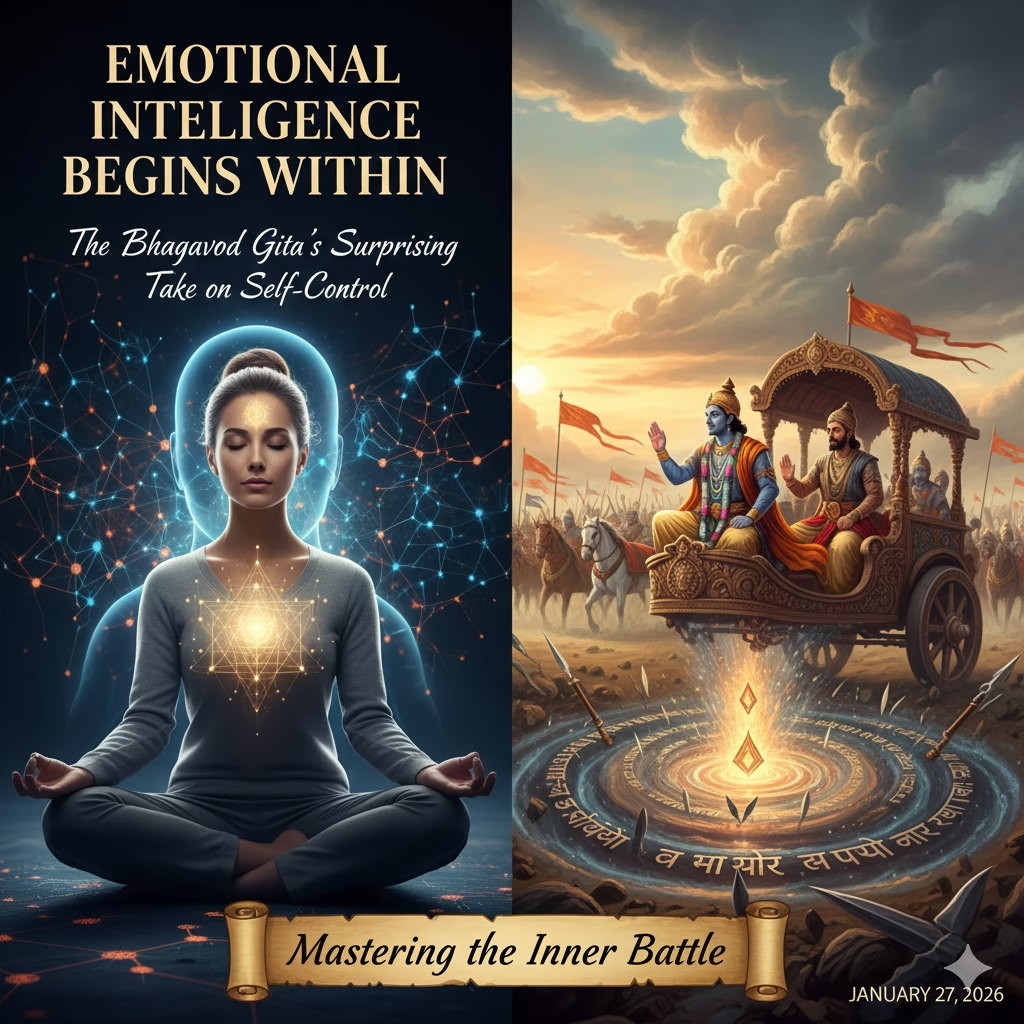
The Bhagavad Gita offers a surprisingly modern insight—one that reframes emotional intelligence not as emotional suppression, but as inner alignment.
The Gita’s Core Insight on Emotional Intelligence (Verse 6.5)
Bhagavad Gita 6.5 states:
“Let a person uplift oneself by one’s own mind; do not degrade oneself.
For the mind can be one’s friend or one’s enemy.”
(uddhared ātmanātmānaṁ nātmānam avasādayet
ātmaiva hyātmano bandhur ātmaiva ripur ātmanaḥ)
This single verse captures a truth modern psychology is still rediscovering:
Your greatest emotional ally—or obstacle—is your own inner world.
The Gita does not blame:
- Other people
- Circumstances
- Children
- Partners
- Team members
It points inward.
The Modern Relationship Challenge
Relationships today face unique stressors:
- Digital distractions
- Emotional unavailability
- Unspoken expectations
- Conflict avoidance or escalation
Often, arguments aren’t about the issue at hand—they’re about unregulated emotions.
Self-Control Is Not Suppression (A Critical Distinction)
One common misunderstanding is that self-control means:
- Bottling emotions
- Being overly disciplined
- Denying feelings
The Gita suggests the opposite.
Self-control means:
- Awareness without judgment
- Regulation without repression
- Choice instead of compulsion
When the mind becomes your ally, emotions are understood, not silenced.
This aligns with modern neuroscience, which shows that emotional regulation improves when emotions are acknowledged—not resisted.
This perspective becomes even clearer when we explore how Sanskrit wisdom for modern life views emotions, responsibility, and self-mastery as everyday skills rather than abstract philosophy.
Why We Lose Self-Control (And Why It’s Human)
The Gita never shames emotional struggle.
It recognizes that:
- The mind is restless
- Habits are strong
- Conditioning runs deep
Loss of self-control often happens when:
- We are tired
- Overstimulated
- Emotionally unfulfilled
Emotional Intelligence Is an Inside Job
Most definitions of emotional intelligence focus on external skills:
- Reading others’ emotions
- Communicating clearly
- Managing conflict
While these are important, the Gita starts deeper.
Before you can manage relationships, leadership, or parenting effectively, you must first understand how your own mind works under pressure.
The verse highlights three revolutionary ideas:
- You are not helpless before your emotions
- Your mind is trainable
- Self-control is an act of self-care, not self-denial
The Mind as Friend or Enemy: A Universal Experience
Think about moments when:
- You said something you immediately regretted
- You overreacted to a small issue
- You carried resentment long after the situation ended
- You felt emotionally drained without knowing why
In these moments, the problem was not intelligence or intention.
It was unexamined inner dialogue.
The Gita doesn’t say the mind is bad.
It says the mind becomes harmful when left unconscious.
This insight applies to everyone:
- Parents managing emotional fatigue
- Leaders under constant decision pressure
- Partners navigating misunderstandings
- Individuals struggling with self-criticism
The Gita’s Guidance
Here’s how to apply the wisdom of Bhagavad Gita 6.5 in everyday life:
- Observe Before You React
Ask:
- “What is my mind saying right now?”
- “Is it helping or harming?”
- Practice Inner Dialogue Awareness
Replace self-criticism with curiosity:
- Not “Why am I like this?”
- But “What is this emotion asking for?”
- Build Pauses Into Your Day
Even brief pauses:
- Before responding to messages
- Before correcting a child
- Before reacting in meetings
Pause is power.
- Repair, Don’t Ruminate
When mistakes happen:
- Acknowledge
- Apologize if needed
- Move forward
Emotional Intelligence as a Lifelong Practice
The Gita does not promise instant mastery.
It offers a path:
- Awareness → Regulation → Clarity
- Inner friendship → Outer harmony
This applies whether you are:
- Single or partnered
- A parent or caregiver
- A leader or contributor
- Young or older
Why This Wisdom Still Matters
Modern life teaches us to optimize everything—except our inner relationship.
The Bhagavad Gita reminds us:
Before managing the world, manage the mind.
Emotional intelligence is not a personality trait.
It is a practice of inner alignment.
And self-control is not about domination—it is about befriending yourself.
Final Reflection
You need to become emotionally aware.
When the mind becomes your ally:
- Relationships soften
- Leadership steadies
- Parenting becomes more conscious
- Inner conflict reduces
This is the quiet power of Bhagavad Gita 6.5.
Not control over life—but clarity within it.
The same inner discipline that governs emotions also plays a crucial role in making ethical choices when situations are complex and outcomes uncertain.
FAQs
1. What does the Bhagavad Gita say about emotional intelligence?
The Bhagavad Gita teaches that emotional intelligence begins with self-awareness and self-regulation. It emphasizes understanding and guiding the mind so it becomes a supportive ally rather than a source of impulsive reactions.
2. How is emotional intelligence connected to self-control?
Emotional intelligence depends on self-control because unmanaged emotions often lead to reactive behavior. The Gita explains that self-control is not suppression but conscious awareness and choice in how emotions are expressed.
3. What is the meaning of Bhagavad Gita verse 6.5?
Bhagavad Gita 6.5 states that a person must uplift oneself through one’s own mind, as the mind can act as a friend or an enemy. This highlights personal responsibility in emotional regulation and inner growth.
4. How does the Gita’s teaching apply to modern relationships?
The Gita’s teaching helps individuals pause before reacting, recognize emotional triggers, and communicate more calmly. This leads to healthier relationships by reducing conflict escalation and emotional misunderstandings.
5. Can the Bhagavad Gita help with parenting challenges?
Yes. The Gita emphasizes emotional awareness and self-regulation, which are essential for patient and emotionally intelligent parenting. Children learn emotional control by observing calm and conscious behavior in adults.
6. How does emotional intelligence affect leadership?
Leaders with emotional intelligence manage stress, respond thoughtfully under pressure, and create psychological safety. The Gita teaches that leadership begins with inner mastery before external authority.
7. Is self-control the same as suppressing emotions?
No. The Bhagavad Gita does not promote suppressing emotions. It encourages understanding emotions clearly and responding consciously rather than being driven by impulsive reactions.
8. Why do people struggle with self-control in modern life?
Modern life increases emotional overload through constant stimulation, stress, and expectations. The Gita explains that without awareness, the restless mind becomes reactive, making self-control difficult.
9. Can emotional intelligence be developed at any age?
Yes. Emotional intelligence is a skill that can be developed at any stage of life through awareness, reflection, and consistent practice. The Gita presents it as a lifelong inner discipline.
10. Is the Bhagavad Gita a religious text or a guide for life skills?
While the Bhagavad Gita originates from ancient Indian tradition, its teachings on emotional regulation, clarity, and self-mastery are practical life skills applicable to people of all backgrounds.
11. How can I practice emotional self-control in daily life?
You can practice emotional self-control by pausing before reacting, observing your inner dialogue, allowing emotions without judgment, and choosing thoughtful responses instead of impulsive reactions.
12. How does emotional intelligence improve family and work life?
Emotional intelligence reduces misunderstandings, improves communication, and creates trust. The Gita teaches that inner clarity naturally leads to harmony in both personal and professional relationships.
Author
-
Deep is a Sanskrit learner and teacher. He has done his Engineering graduation from IIT Kanpur. He worked in the Information Technology sector serving Investment banks for ten years. He served as a Counsellor, Life Coach and Teacher, post his corporate career.
View all posts
Deep pursued the study of scriptures in search of the hidden treasures of valuable knowledge shared by the Rishis. In the process, he realized the need to learn Sanskrit. He, therefore, learned Sanskrit through self-study and Certification courses. Presently he spends a good chunk of his time sharing useful Sanskrit resources with all the Sanskrit lovers.
You can reach him at deep@iitkalumni.org.